


Prarthana Hazarika
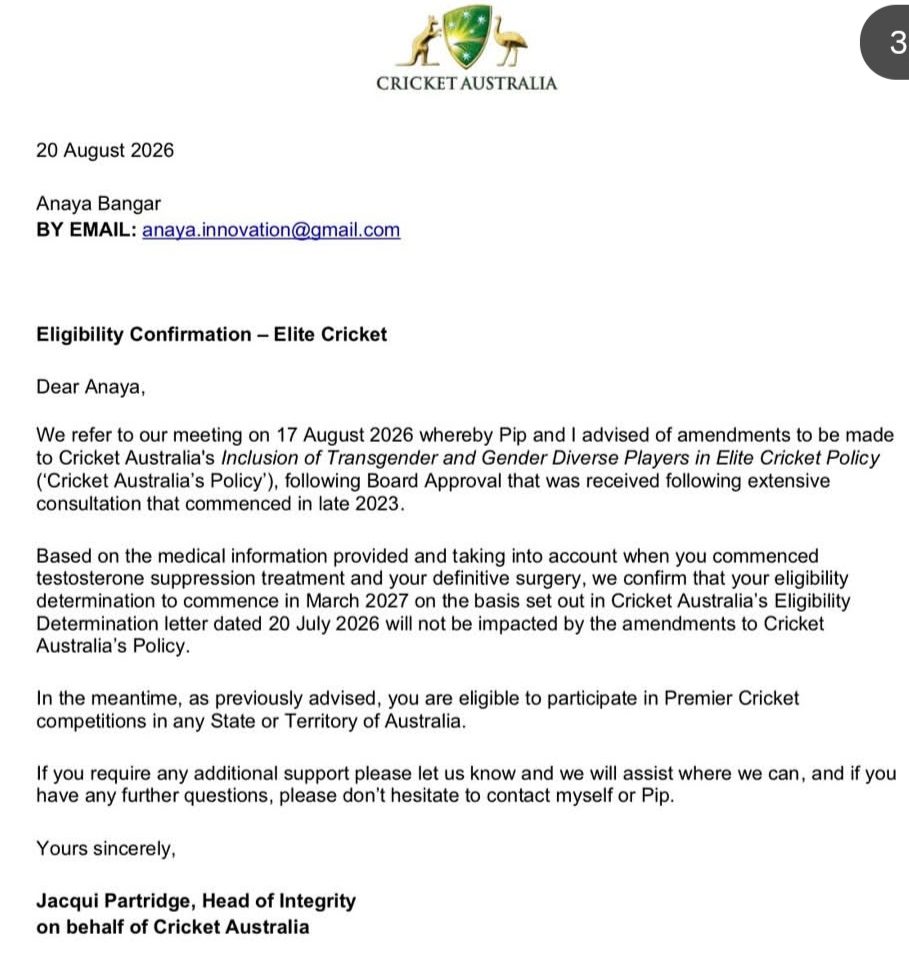
Guwahati, Aug 31: Anaya Bangar’s pathway towards elite women’s cricket in Australia has raised a larger question for Indian cricket — does the BCCI need a clear policy on transgender participation in the women’s game?
Speaking exclusively to Meghalaya Sports, Supreme Court Senior Advocate Saurabh Mishra said the debate must balance a transgender athlete’s constitutional rights with the legitimate need to preserve competitive fairness.
“Transgender persons are entitled to equality, dignity and protection against discrimination,” Mishra said, referring to the Supreme Court’s landmark NALSA v. Union of India judgment.
At the same time, he stressed that constitutional protection does not automatically mean an unconditional right to compete in every sex-segregated sporting category.
“Competitive sport can legitimately prescribe eligibility criteria where there is a rational and evidence-based basis for doing so, particularly in a women’s category where the objective of preserving competitive fairness is itself legitimate,” he said.

According to Mishra, any restriction must be based on objective criteria, have a legitimate sporting purpose, be proportionate and non-arbitrary, while giving an athlete a fair opportunity to have her eligibility assessed.
The Anaya Bangar case, he believes, highlights the need for clarity from the BCCI.
“The ICC already has a defined framework for international women’s cricket, while domestic eligibility is left to the respective member boards. Cricket Australia, too, has a published transgender and gender-diverse player policy,” Mishra said.
“In that background, an athlete should not be left in a situation of uncertainty as to whether and how her eligibility will be assessed.”
Mishra said the BCCI should consider a transparent framework covering eligibility criteria, scientific and sporting parameters, individual assessment, confidentiality safeguards and an independent review or appeal mechanism.
“That would protect both the transgender athlete’s right to fair treatment and the legitimate interest of other women athletes in maintaining a fair competitive environment,” he said.
His conclusion is clear: “The constitutional objective should not be framed as a choice between equality and fairness. A properly designed regulatory framework should seek to advance both.”
Bangar’s Australian pathway may therefore be more than an individual sporting journey. It could force Indian cricket to confront a policy question that has so far remained largely undefined.