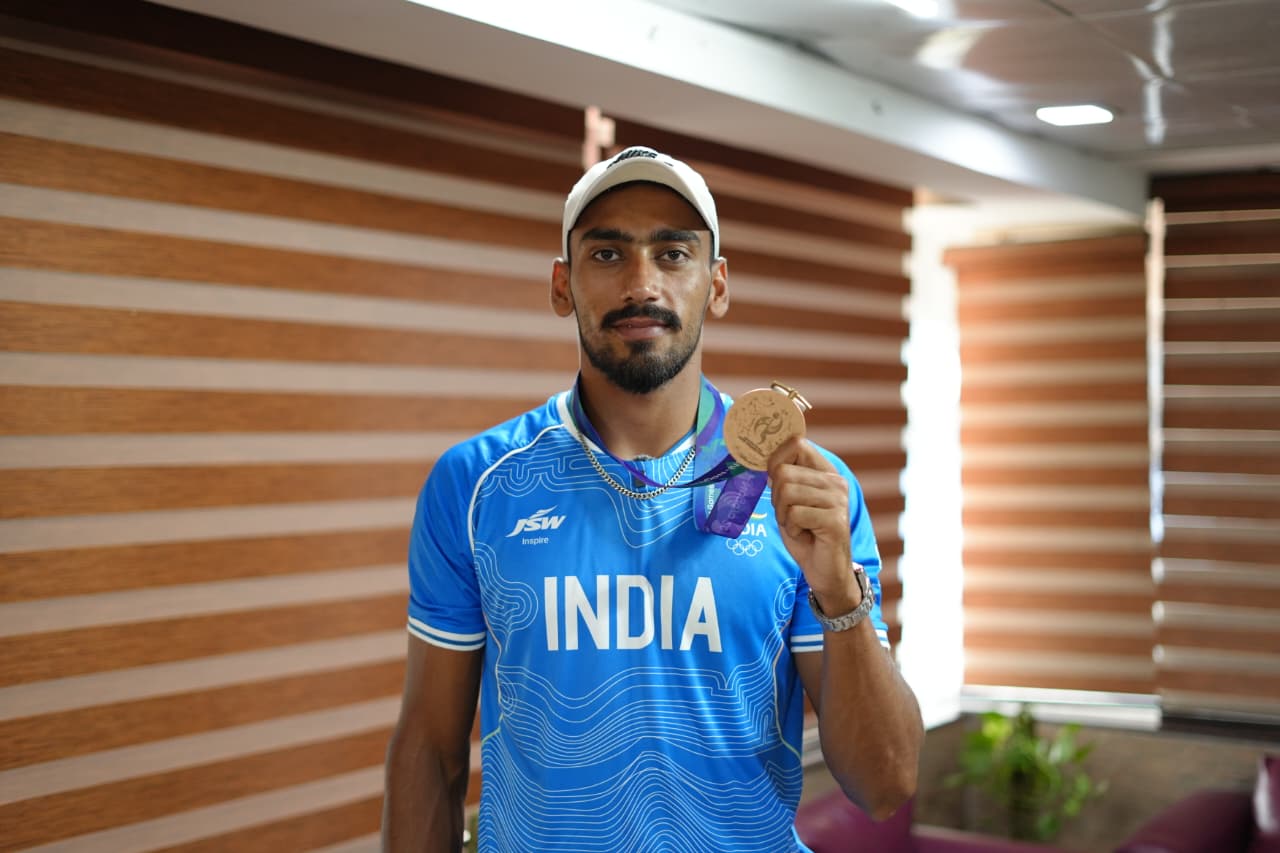


New Delhi, October 8: Indian rower Satnam Singh believes the historic bronze medal in the men’s Double Sculls at the Aichi-Nagoya Asian Games has marked a new beginning for Indian rowing and could pave the way for greater success in the years ahead.
Satnam, who partnered Salman Khan to win bronze in the men’s Double Sculls, said the medal has opened up new possibilities for Indian rowers after decades of waiting.
“The paths that had been blocked have now opened. We can now hope that we will win more medals in this event in the future and perform even better,” Satnam told SAI Media.
India had never previously won a medal in the men’s Double Sculls event at the Asian Games since the continental Games began in 1951. The Indian duo clocked 6:13.25 at the Nagaragawa International Regatta Course to secure the historic bronze.
For Satnam, the medal was also his second Asian Games bronze, having previously finished third in the Quadruple Sculls at the Hangzhou Asian Games.
The 26-year-old Indian Navy rower believes experience has been crucial to his development and that of his teammates.
“When a player is new, there is naturally pressure in competition. As you continue playing, your experience increases, your confidence grows and the fear starts to reduce. That is very important for an athlete,” he said.
European exposure helping Indian rowers
Satnam also credited the changing support structure around Indian rowing, particularly overseas exposure through the Target Olympic Podium Scheme (TOPS), for helping Indian athletes close the gap with the world’s leading rowing nations.
“This was the first time we had camps in Europe. We also got the opportunity to race against some of the world’s top-class countries before the Asian Games. That gave us a chance to understand our level against the best,” he said.
According to Satnam, Indian rowers are now competing much closer to European teams than they did in the past.
“Earlier, we were much further behind. But now, when we race against European countries, we are finishing around three to four seconds behind them,” he added.
He also highlighted the contribution of coaches, improved technology and greater support to the sport’s progress in India.
“As the coaches continue to support us, new things and new technology are coming into the sport, and we are continuing to work. Because of that, Indian rowing is progressing significantly,” Satnam said.
Eyes on LA 2028
With the Los Angeles 2028 Olympics now the next major target, Satnam is hopeful that India’s improving standards can translate into Olympic qualification across multiple events.
“At the moment, we are very hopeful about the Los Angeles Olympics. The effort will be to qualify in as many events as possible,” he said.
Satnam believes the gap with the world’s best is narrowing and that Indian rowing can aim even higher at the Asian Games and Olympics.
“We are hopeful that going forward, we can also win gold at the Asian Games. We will always keep trying for that. And for the Olympics, our hope is to participate and go all the way to the final,” he said.
For Indian rowing, the Aichi-Nagoya bronze could therefore prove more than just another medal—it could be the foundation for a sustained push towards the top of Asian and global rowing.