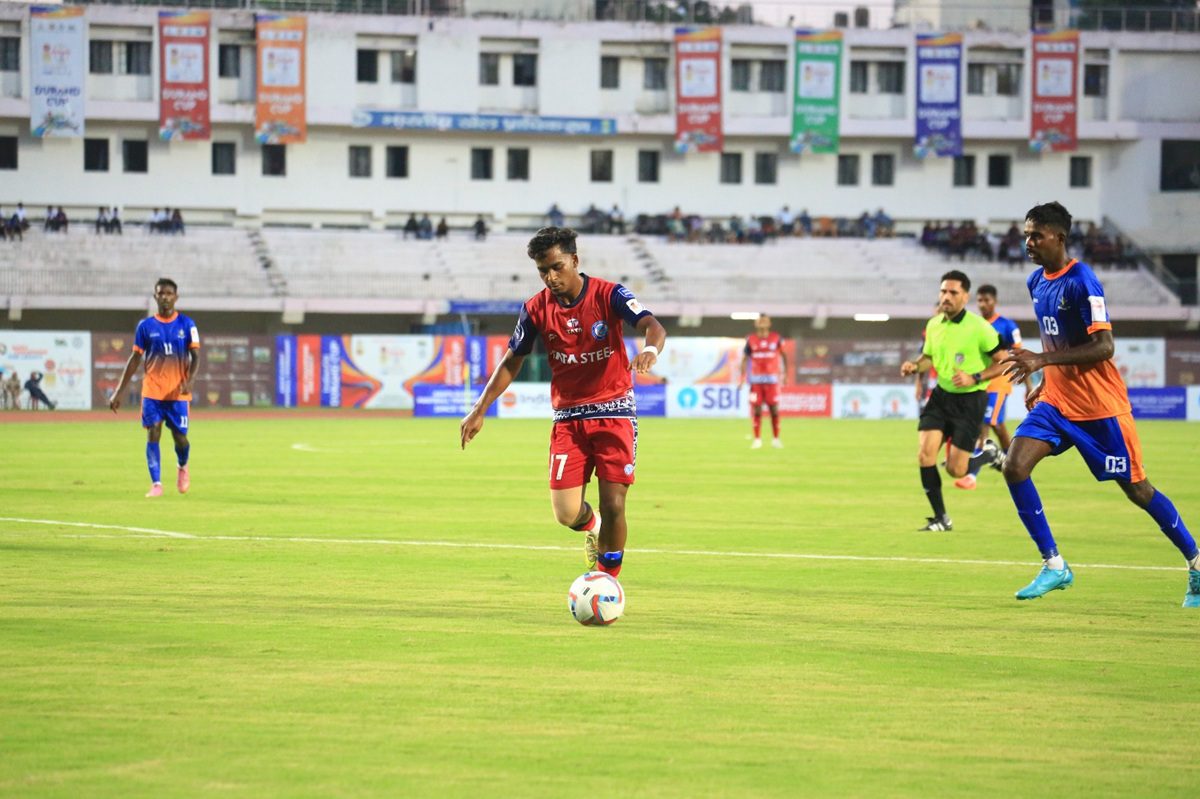


Ranchi: Most footballers spend their careers performing for strangers. Every so often, one has to walk out in front of the people who watched him fail first, who remember him before the club badge and the crowd noise, and that is a different kind of pressure entirely, harder to train for. Nikhil Barla wore it plainly on Sunday evening, in the tunnel of the Birsa Munda Football Stadium, waiting to lead Jamshedpur FC out against Defenders FC of the Sri Lankan Armed Forces. Twenty-two years old, a right-back these days more often than not, about to play a competitive match in his home city for the first time in his professional life.
It had taken a while to get here. Not in miles, though Ranchi sits only a few hours from Jamshedpur by road. What had taken a while was the tournament itself. The Durand Cup is 135 editions deep, the third-oldest football competition still standing anywhere in the world, older than the World Cup, older than most of the nations that now compete in it. It has been staged in army cantonments and steel-town stadiums, in Kolkata and Guwahati and Shillong and Imphal. It had never, in 138 years, come to Jharkhand’s capital. Until this month, when the trophy tour rolled through Dipatoli Military Station with Santhali dancers and Chhau performers, a crowd more interested in the silverware than the schedule.
A Village Without a Pitch
For Nikhil, the wait had a more personal shape to it. He does not, strictly, come from Ranchi. He comes from Khunti, a district further out, a place he has described to interviewers as a village of mud houses with no electricity, where the pitch was a vacant plot and the ball was played barefoot with whoever showed up that evening. His family moved to Ranchi when he was three, which makes the city less a birthplace than an adopted home, though the distinction has clearly stopped mattering to him. He still goes back to Khunti to see his grandmother. Ranchi is where he calls learning to love the game properly, in college, on grounds a long way removed from the Salt Lake Stadiums the sport later took him to.
“I started playing football here in Ranchi during my college days,” he said afterward, still catching his breath a little. “This is the first time the Durand Cup is being held here, and I am very grateful. Playing in front of my family, friends and supporters is a wonderful feeling.”
It is worth sitting with what that sentence describes. Indian football’s geography of opportunity has long run through a handful of well-worn channels — Kolkata, Goa, Kerala, the Northeast and Jharkhand, for all its raw talent, has mostly watched from outside them. Nikhil is one of the state’s clearer arguments against that arrangement. The Tata Football Academy picked him up in 2018 and kept him until 2021, before he stepped up to Jamshedpur FC’s first team. Along the way he wore Jharkhand’s colours at the Santosh Trophy and was named Man of the Match twice, proof that the state’s football culture runs deeper than its ISL representation suggests.
The rise has not been conventional, either. Jamshedpur signed him as a winger, and he spent his early seasons mostly in flashes off the bench, three assists spread thin across a campaign, the kind of contribution that earns a contract extension but not yet a name people ask about. It was Khalid Jamil, midway through a season with a leaking right-back slot, who moved Barla into defence out of necessity more than any grand plan. “I’m comfortable playing in both positions,” Barla said at the time, with the pragmatism you learn early when your football education happens on borrowed pitches, “but it depends on where the coach wants me to play. All I want is to play.” He has barely left the position since, and in February he scored his first ISL goal from it anyway, arriving late into the box against Mohammedan SC for a moment he called one he would always cherish.
None of that history was really the point of Sunday. The point was simpler, and Barla said as much himself: that his family was in the stadium, that friends who had watched him kick a ball around as a teenager were somewhere in the stands of a ground that had been repainted and rebranded and fitted out with the full ceremony the Durand Cup demands of its hosts. “It means a lot because your family is watching you play,” he said. “It’s emotional as well, and I am very happy.”
Five Goals, One Homecoming
Jamshedpur made sure the emotion had somewhere pleasant to land. New signing Raynier Fernandes marked his own debut with a hat-trick, and the Red Miners ran out 5-0 winners in front of a crowd that had queued for free tickets days in advance. Barla started at right-back in an all-Indian XI, a detail the coaching staff will have noted with satisfaction given the club’s recent struggles to escape the group stage in this competition. It was not the kind of afternoon that asks searching questions of a defence. It was, instead, the kind that lets a hometown story breathe a little.
Paying It Forward
Barla, to his credit, did not let the occasion stay purely personal. Asked what Ranchi’s arrival on the Durand Cup map meant beyond his own evening, he pivoted quickly to the state’s next generation, the players who do not yet have his TFA badge or his contacts book. “Tournaments like this are always beneficial for young footballers,” he said. “They get a chance to watch top players and learn from them. It is very good for the development of football in Jharkhand.” It is the kind of quote athletes give reflexively, except Barla has standing to give it: he is, more or less, the model he is describing, a boy from a village without a proper pitch who ended up playing in front of his own city in a tournament founded in 1888. His advice to the players coming up behind him was stubbornly unglamorous. “There are many talented players here. They should practise every day, listen to their coaches and attend trials as early as possible. That will be good for their future.”
What he wants for himself is less complicated, and he did not dress it up. He has already had one brush with this trophy and come away with nothing — three appearances back in the 2021 edition, in and out of a Jamshedpur side that never threatened the business end of the tournament. “Personally, I want to win the Durand Cup with Jamshedpur FC,” he said. “When I started my professional career here, I couldn’t achieve that. This is a great opportunity, and I hope we can go all the way and win the trophy.”
There is a version of this story that writes itself as pure sentiment. A local boy, home soil, family in the stands and a truer version underneath it, about a state still building the infrastructure to keep its footballers rather than export them elsewhere. Ranchi will host seven matches this Durand Cup, including a quarter-final on August 16, and whatever happens between now and then, the tournament’s arrival has already done something the record books will note quietly: it gave a boy from Khunti, by way of Ranchi’s college pitches and Jamshedpur’s academy dormitories, a stadium full of people who watched him become who he is. He walked off it a winner. Whether Jharkhand keeps producing more like him is the story that begins now.
Note: This feature article was contributed by the Durand Football Tournament Society.