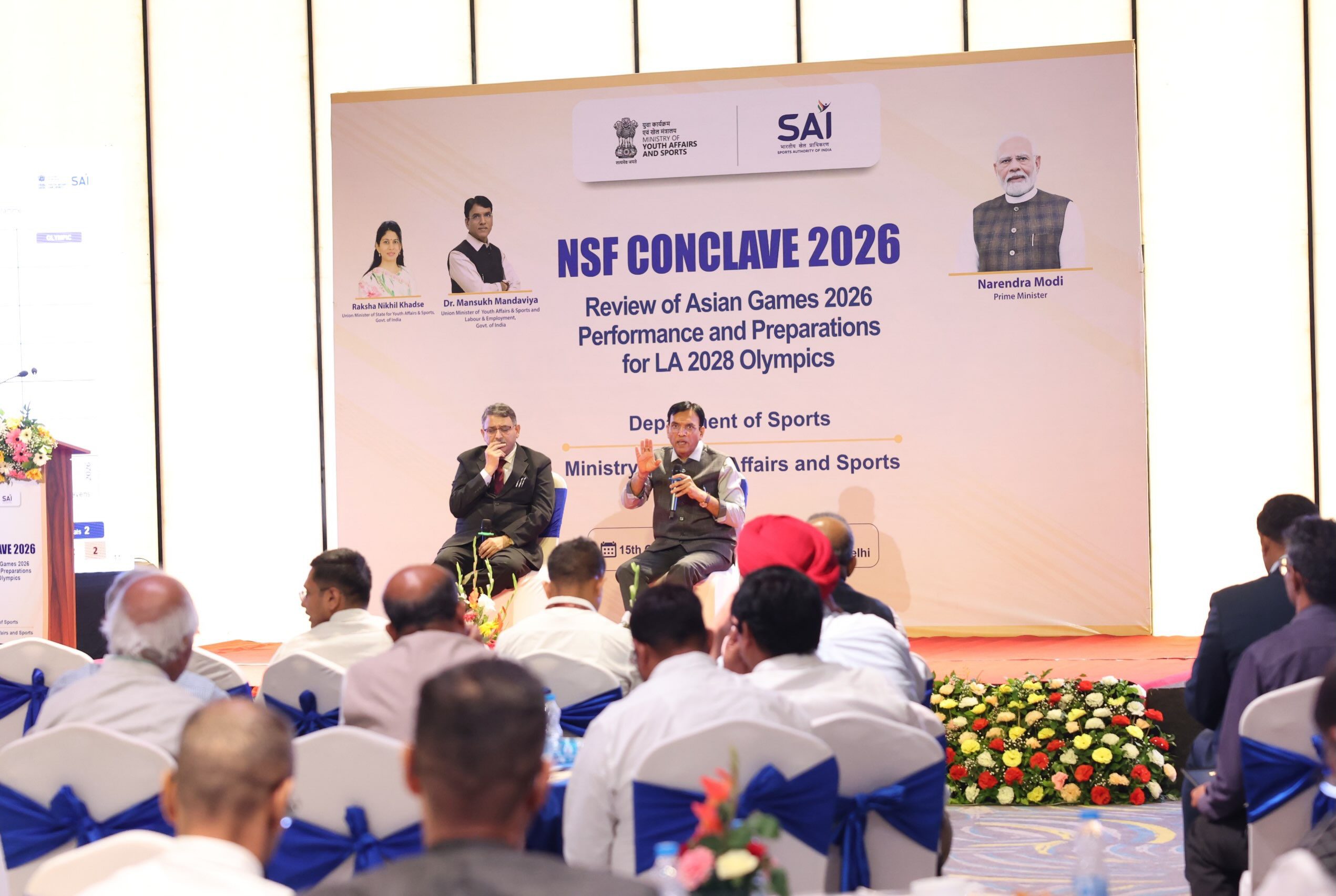


New Delhi: Union Sports Minister Mansukh Mandaviya has demanded greater accountability and improved performance from National Sports Federations (NSFs) following India’s disappointing medal tally at the 2026 Asian Games in Aichi-Nagoya, setting ambitious targets for the country’s sporting future.
During a review meeting in New Delhi, Mandaviya stressed that federations must translate government support into tangible results, improve athlete development systems and focus on building a strong pipeline of future champions.
India finished fourth at the Aichi-Nagoya Asian Games with 85 medals, comprising 21 gold, 27 silver and 37 bronze. The tally marked a decline from the 106 medals, including 28 gold, won at the 2023 Hangzhou Asian Games.
The minister made it clear that financial constraints could not be used as an excuse for underperformance, emphasising that the government was providing adequate resources and support to develop Indian sport. The focus, he indicated, must now shift towards effective implementation, measurable progress and greater responsibility from the federations entrusted with preparing athletes for major international competitions.
Officials stressed the need to move away from an over-reliance on individual stars, such as weightlifting champion Mirabai Chanu, and instead develop greater depth across disciplines. Federations were urged to establish a stronger talent pipeline, ensuring that India’s medal prospects do not depend on a handful of established athletes.
Strengthening grassroots development and creating a systematic pathway from district and state-level competitions to the national and international stages were also identified as key priorities.
India’s next major continental ambition is to finish among the top three nations at the 2030 Asian Games in Doha. Achieving that target will require sustained planning, improved talent identification and stronger coordination between the government, sports federations, coaches and support staff.
The 2030 Commonwealth Games, which India is scheduled to host, was also identified as a major test for the country’s sporting system. The expectation is to surpass India’s performance at the 2010 Commonwealth Games in Delhi, where the hosts won 101 medals, including 38 gold.
The review also addressed administrative shortcomings within national federations. Officials called for an end to internal politics and urged NSFs to work more closely with state and district associations to strengthen the sporting ecosystem.
Federations were also cautioned against sending injured athletes to major competitions without properly assessing their fitness, underlining the need for more responsible selection and decision-making.
The importance of sports psychologists and mental trainers was highlighted, recognising that elite performance requires psychological preparation alongside physical conditioning and technical development.
With the 2030 Asian Games and Commonwealth Games on the horizon, the message from the sports ministry was clear: government investment must translate into results, and federations will be expected to demonstrate greater accountability as India seeks to strengthen its position in international sport.