

Deepak Singh
Shillong, Aug 6: Just two years ago, Langsning Football Club was staring at an uncertain future. Financial constraints had pushed one of Meghalaya’s most successful clubs to the verge of closure, with no one willing to shoulder the burden of keeping it alive.
Today, the club is one of the biggest talking points of the 135th IndianOil Durand Cup.
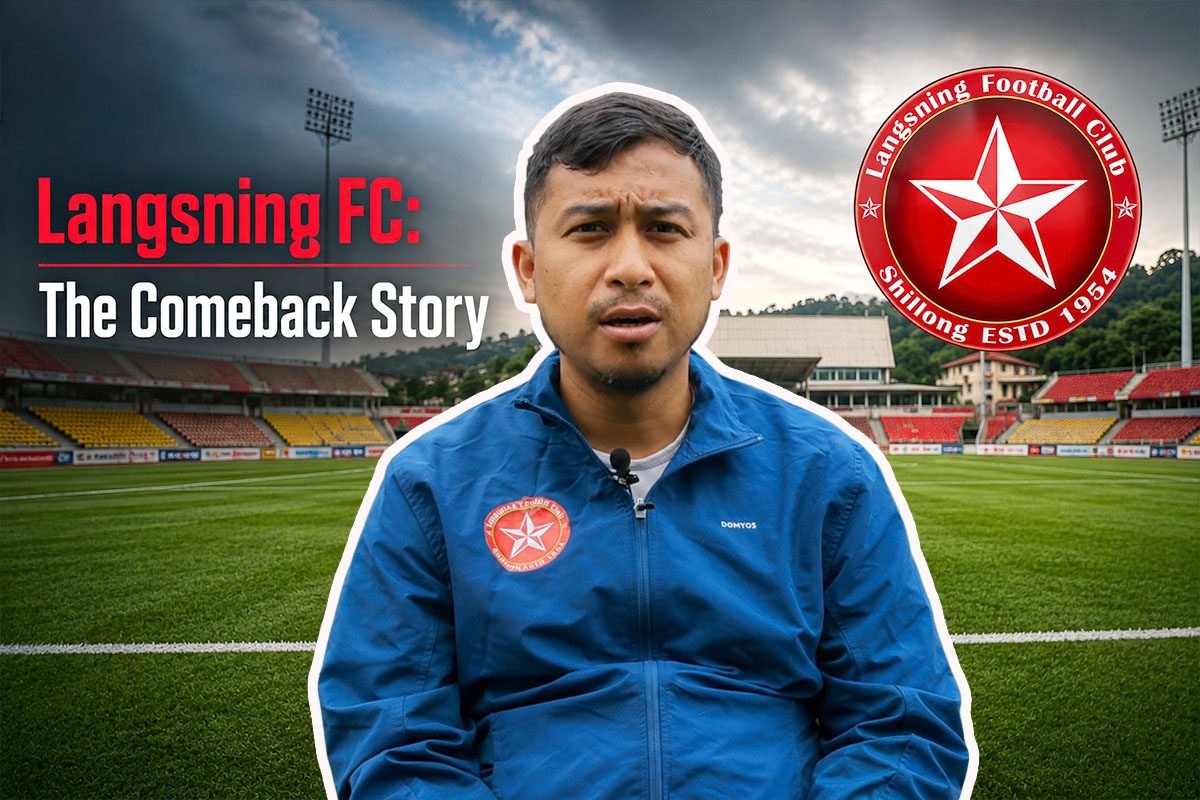
After announcing their arrival on the national stage with a stunning 5-0 victory over Mumbay FC in their tournament debut, Langsning have suddenly become a team that football fans across the country are beginning to notice. For the club’s Chief Executive Officer, Bankit Pakyntein, however, the scoreline is only one chapter in a story that almost never happened.
“First and foremost, all glory to God,” Pakyntein said. “It’s a miracle, honestly.”
That sense of disbelief stems from where the club found itself only two years ago.
According to Pakyntein, the previous management could no longer cope with the financial demands of running the club. With no immediate successor in sight, Langsning faced the real possibility of shutting its doors permanently.
“It was a difficult time,” he recalled while speaking to Meghalaya Sports. “The previous ownership could not handle the expenses anymore and there was nobody to take over the club.”
It was then that members of the Jaiaw Langsning community approached Pakyntein’s father, Banteidor Lyngdoh, who had previously been associated with the club and is now the MLA for Mawkynrew constituency. They hoped he could help prevent one of Meghalaya’s oldest football institutions from disappearing.
After several discussions with family members and friends, Lyngdoh, along with close associates Banrikupar Lyngwa and Kynsai Manik Jyrwa, agreed to take over the club, with former minister and incumbent West Shillong MLA Paul Lyngdoh serving as chief patron. Together, they made a decision that would change Langsning’s future.
“We said, ‘Let’s just take this risk’,” Pakyntein said. “We didn’t know what expenses we would have to bear. Our only thought was to keep the club running, maybe just for that year. If we didn’t take over, the club would have been dissolved.”
Founded in 1954 by the Seng Samla (Youth Association) of Jaiaw Langsning, the club has been part of Shillong’s football heritage for more than seven decades. Over the years, Langsning has built a proud reputation as one of Meghalaya’s most successful football institutions, winning multiple First Division titles and three Shillong Premier League titles while producing generations of footballers. By 2024, however, the club was fighting for survival. Mounting financial challenges had pushed Langsning to the brink of closure, putting nearly 70 years of footballing history at risk.
“Langsning has a rich history,” Pakyntein said. “To see a club like that dissolve would have been heartbreaking for the fans and everyone connected with it.”
What followed has exceeded even the expectations of those who stepped in simply to keep the club alive. Within a year of the takeover, Langsning emerged as Shillong Premier League champions. This year, they reached the final of the 5th edition of Meghalaya State League (MSL) before earning an invitation to compete in the prestigious 135th IndianOil Durand Cup.
Then came the statement that captured national attention.
Facing Mumbay FC in their opening Group E fixture on August 3, 2026, Langsning produced one of the tournament’s most dominant displays, cruising to a 5-0 victory and announcing themselves as genuine contenders.
“I still can’t express it in words,” Pakyntein admitted. “A team that was about to be dissolved, then winning the Shillong Premier League, reaching the Meghalaya State League final and now winning 5-0 in our Durand Cup debut… it’s a miracle.”
While the result surprised many outside Meghalaya, those within the club believed it reflected months of careful planning.
Understanding that the Durand Cup would demand a higher standard than domestic competitions, Langsning embarked on an ambitious recruitment drive, bringing in as many as 10 new players ahead of the tournament.
The decision was not driven by glamour but by necessity. Pakyntein recalled that as soon as Langsning received the invitation to play in the Durand Cup, the management sat down to discuss how the club could compete at that level. Their resolve was clear – they were not going to be bullied by other teams on the national stage. Instead, they wanted to play their brand of football and show they could compete with the country’s best.
“The level of football in the Durand Cup is much higher than the level here in Shillong, so we expect our players to perform much better. We couldn’t just go there and be bullied by other teams or be thrashed by them. We wanted to go there and play our football. We wanted to compete with teams from across the country,” he said.
The new arrivals quickly transformed the squad. Watching the team during training, Pakyntein sensed the quality had improved considerably, although he admitted he remained anxious when Langsning struggled to convert chances in the opening half against Mumbay FC.
Those concerns disappeared after the break. “We were able to capitalize in the second-half. We pushed and the players finally showed the fruits of all those practice sessions… seeing the team play like that, the players playing freely, it’s quite a journey,” he said.
Talking about the new signings, he said, “All of them played very well and it made us, the team management of the club, happy. I can’t put into words. I feel confident, I feel assured that this club is going forward and that we can expect so much more.”
For Pakyntein, however, Langsning’s revival is about more than the club’s own success. He believes it reflects the immense footballing talent that has long existed in Meghalaya, with its growth often limited by a lack of opportunities and exposure. He hopes Langsning’s journey will inspire more local footballers to believe they, too, can succeed on bigger stages.
“We know football is in our blood here,” he said. “We have talented players in Shillong and across Meghalaya. We want to show the rest of the country that Meghalaya is a football hub.”
Pakyntein believes the breakthrough many have been waiting for is not far away. “Maybe a player from Meghalaya is about to explode onto the national scene. Maybe a club from Meghalaya will do it,” he said. “The talent is already here.”
For a club whose immediate goal two years ago was simply survival, those ambitions may once have sounded unrealistic. Today, after one of the most remarkable revivals in recent Indian football, they no longer seem quite so far-fetched.