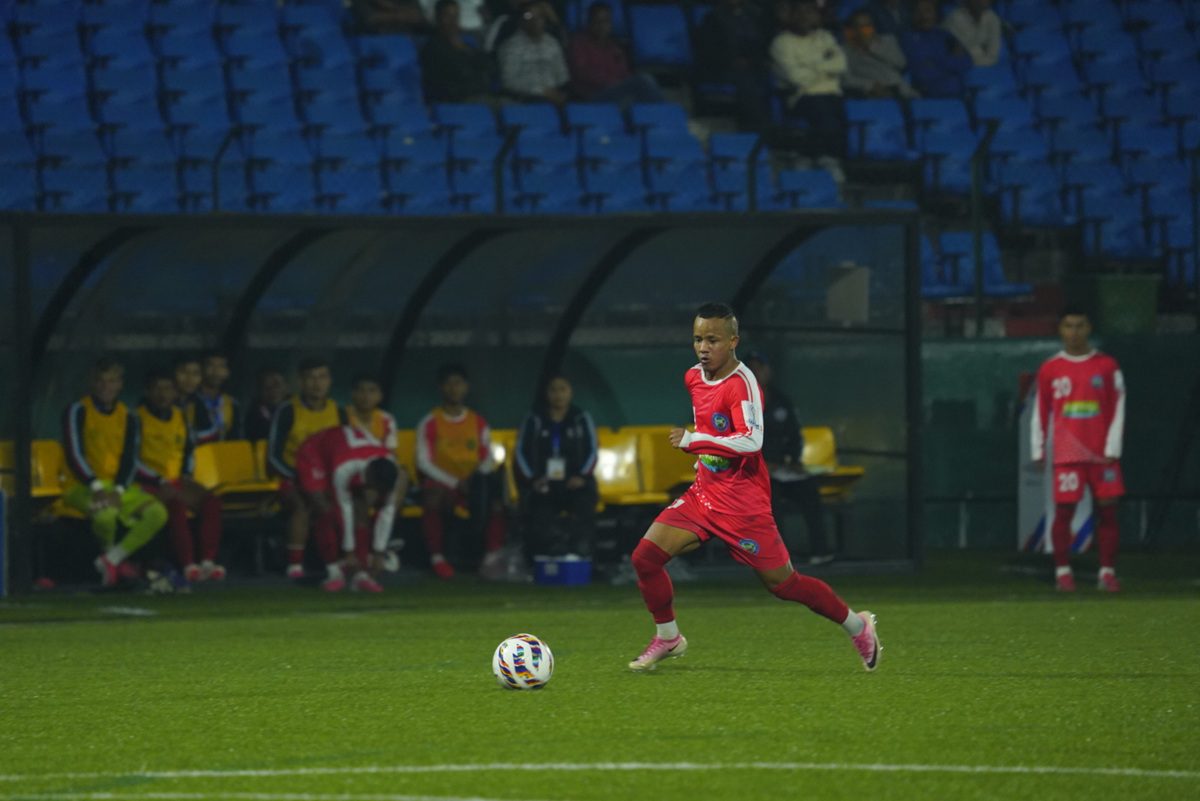


Deepak Singh
Nongkseh Sports Social & Cultural Club’s clash with Lakecity FC is almost upon us as the two face-off at the SSA Stadium on Wednesday evening. But before the home side faces the visitors from Bhopal, we take a look back at the Sky Blue Army’s performance against the Chhaygaon FC from neighbouring Assam.
Nongkseh Sports & Cultural Club’s 4-0 victory over Chhaygaon FC on October 24 was a result that reflected more than the difference in goals scored. Nongkseh demonstrated their ability to sustain attacking pressure, capitalise on defensive mistakes and turn a closely contested opening period into a commanding second-half performance.
Yet, the game was not as straightforward as the final score might suggest. Chhaygaon had opportunities to test Nongkseh, their goalkeeper made several important saves, and the home side missed a number of chances before establishing a comfortable lead. The decisive difference emerged as the match progressed as Nongkseh continued to create opportunities, while Chhaygaon struggled to sustain their attack
Chesterpaul Lyngdoh’s opportunistic opener in the 35th minute gave Nongkseh the advantage. Captain Hardy Cliff Nongbri doubled the lead with a header in the 57th minute before converting a penalty in the 89th. Owanijuh Pajuh completed the scoring with a powerful strike in the third minute of stoppage time.
The opening half: Attacking pressure without clinical finishing
The opening exchanges were energetic and physical, with both teams competing aggressively for possession. However, as the first half progressed, Nongkseh began spending more time in the attacking half, forcing Chhaygaon to concentrate on defending their penalty area.
Nongkseh’s attacking approach generated opportunities through crosses, corners and forward combinations. Chesterpaul tested the Chhaygaon goalkeeper in the 12th minute, while further attempts followed as Nongkseh continued to move the ball into dangerous areas.
Nevertheless, the number of opportunities did not immediately translate into goals.
This was an important feature of the first half. Nongkseh were able to reach threatening positions, but their finishing lacked to establish an early lead. Chhaygaon remained in the contest partly because their goalkeeper intervened at crucial moments and the defence managed to survive several dangerous situations.
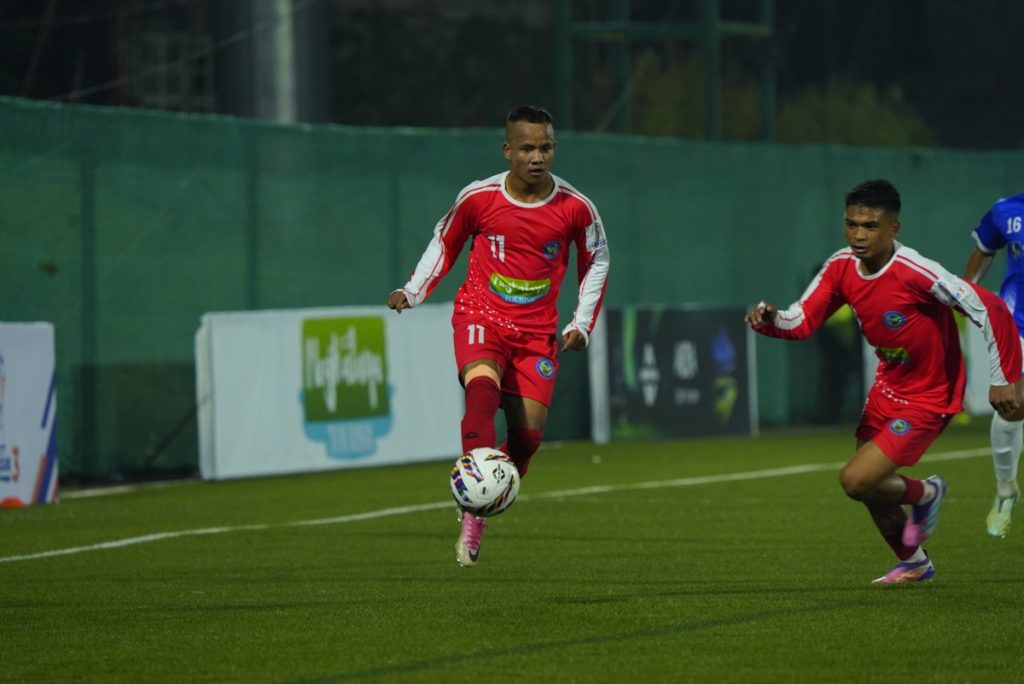
Chhaygaon were not entirely passive, either. They produced attempts that required intervention from Nongkseh goalkeeper Wanteilang Malngiang, demonstrating that the visitors could threaten when opportunities arose.
However, there was a difference between creating an occasional opportunity and maintaining sustained attacking pressure. Nongkseh repeatedly returned to the attacking third, whereas Chhaygaon’s threatening moments were less frequent.
The first half therefore revealed both Nongkseh’s strength and an area requiring improvement. Their ability to generate opportunities was encouraging, but their failure to convert several of them allowed Chhaygaon to remain competitive for longer than the balance of play might otherwise have suggested.
Chesterpaul’s opener: The significance of pressing and defensive concentration
The breakthrough arrived in the 35th minute, when Chesterpaul Lyngdoh intercepted a return pass from Chhaygaon defender Aryan Nakra following a pass from goalkeeper Kaji Md Nadish.
Chesterpaul reacted quickly, advanced past the goalkeeper and finished into the net.
The goal was significant not only because it ended the deadlock, but also raised questions about Chhaygaon’s tactics given the risks involved in building from the back and at a time when Nongkseh had already started to look threatening. A return pass requires precise execution and awareness of the opposition’s positioning. In this instance, Chesterpaul was alert, given his experience, and recognised the opportunity before the defender could recover.
For Nongkseh, the goal rewarded their persistence. They had spent much of the first half attempting to break down Chhaygaon’s resistance, and the breakthrough gave them a tangible advantage after a period in which several chances had gone unconverted.
The psychological implications were also important, although they cannot be established from the scoreline alone. Nongkseh could now attack with the confidence of a team in front, while Chhaygaon faced the additional responsibility of finding an equaliser.
The first goal did not immediately settle the contest. It did, however, change the conditions under which both teams had to approach the remaining minutes.
The second half: Why Nongkseh’s pressure became decisive
The most important development came after the interval.
Nongkseh continued to attack rather than simply protect their narrow lead. Hardy Cliff Nongbri tested the Chhaygaon goalkeeper around the 50th minute, and further opportunities followed as the home side maintained its presence in the opposition’s half.
The second goal arrived in the 57th minute. Ieitlang Syiemlieh advanced from around the halfway line and delivered a pass across the penalty area, allowing Hardy to arrive and direct a low header past Nadish.
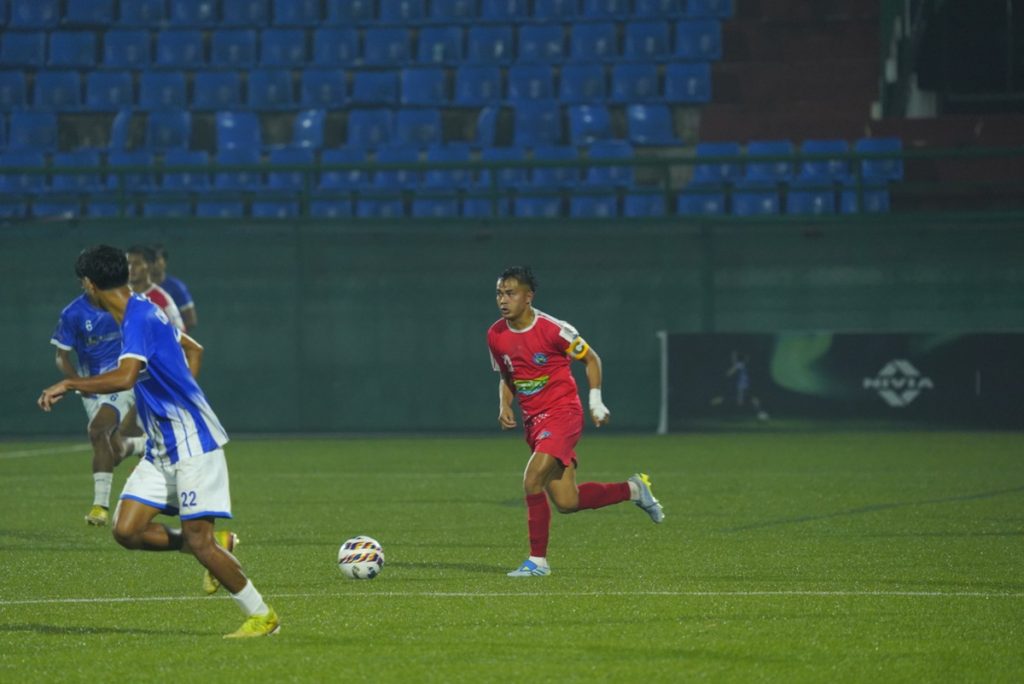
Unlike the opening goal, which resulted from a defensive mistake, the second was the product of an attacking movement that combined forward progression, delivery and finishing.
Ieitlang contribution deserves particular attention. His movement helped carry the attack into a dangerous area, while his delivery gave Hardy the opportunity to finish. Hardy, a veteran with vast experience across various divisions and leagues, recognized the opportunity and placed himself at the perfect position to receive the ball and convert it. However, the low header itself was something very few could have executed with the perfection that Hardy did, who made the header look almost too easy as he sent the ball across the goalkeeper and into the net.
At 2-0, the match entered a different phase.
Chhaygaon now had to score twice to draw level. That situation increased the importance of their attacking decisions, but it also risked exposing them to further pressure if they committed more players forward.
Nongkseh, meanwhile, could continue exploiting the opportunities presented by their opponents’ need to recover the deficit.
The second goal therefore mattered beyond its numerical contribution. It gave Nongkseh a greater margin for error and made Chhaygaon’s task considerably more difficult.
The goalkeeper’s saves kept the scoreline respectable
Although Nongkseh eventually scored four times, Chhaygaon goalkeeper Kaji Md Nadish made several saves that prevented the deficit from widening earlier.
Nongkseh continued to test him through the second half. Lyngdoh had further attempts around the 63rd and 64th minutes, while another attacking movement involving Hamedamanbha, Chesterpaul and Owan produced a chance around the 65th minute.
Nadish performance cold go under the radar since the result did not go in their favour but his performance was what kept the final scoreline respectable for Chhaygaon.
However, his saves could only address the immediate threat. They could not resolve the wider problem of allowing Nongkseh to return repeatedly to dangerous positions.
The defensive unit needed to limit the number of opportunities reaching the goalkeeper in the first place. As the match progressed, that became increasingly difficult.
For Nongkseh, the repeated saves were not necessarily a reason to change their approach. Their ability to generate another opportunity after a missed chance was one of the defining characteristics of the performance.
Hardy’s influence: More than just two goals
Hardy Cliff Nongbri’s contribution was central to the result.
The captain scored Nongkseh’s second goal in the 57th minute, converting Ieitlang’s delivery with a low header. He then converted a penalty in the 89th minute to extend the lead to 3-0.
The brace reflected two different aspects of his attacking contribution. The first goal required movement and finishing during open play, while the second demanded composure from the penalty spot.
His influence also gave Nongkseh a reliable finishing option as the match progressed.
The second goal was particularly important because it arrived at a point when Chhaygaon could still have hoped to recover from the opening deficit. By doubling the advantage, Nongbri helped move the contest away from a potentially close finish.
His penalty then removed any remaining uncertainty about the outcome.
What can be said with confidence is that his finishing proved decisive against Chhaygaon. When Nongkseh needed a second goal to strengthen their position, he delivered. When they earned a penalty late in the game, he converted again.
For a captain, such contributions carry obvious significance.
Chhaygaon’s problem: Resisting pressure was not enough
Chhaygaon did not collapse immediately after conceding the opening goal. Their goalkeeper continued making saves, and the team had moments when they attempted to move forward and create opportunities.
The problem was sustaining those moments.
Nongkseh repeatedly returned to the attacking half, forcing Chhaygaon to defend again. As the second half progressed, the visitors struggled to turn their occasional advances into sustained pressure of their own.
Their defensive error for the opening goal was costly, but the defeat cannot be explained by that incident alone.
Their own attempts also failed to produce a goal, leaving them without a response when Nongkseh extended the lead.
Owan’s late strike: A fitting end to Nongkseh’s performance
The final stages reinforced the difference between the teams.
Owan had a header ruled offside in the 75th minute, and Nongkseh continued to create opportunities thereafter. Hardy’s penalty in the 89th minute made it 3-0, but the home side did not stop attacking.
In the third minute of stoppage time, Owan collected the ball around the edge of the penalty area and unleashed a powerful strike into the top-left corner. The goal completed the 4-0 victory and provided one of the match’s most memorable finishes.
It also highlighted an important feature of Nongkseh’s performance – their willingness to continue looking for goals even after establishing a comfortable advantage.
That approach produced a fourth goal, although the broader lesson is not simply that more attacking automatically leads to a better result. Rather, Nongkseh maintained their attacking intent and were rewarded when Owan found the space and execution required to finish.
What Nongkseh must take forward
The victory offered several encouraging signs for Nongkseh, but the performance also identified areas for further improvement.
Their attacking persistence was a major positive. The team continued creating chances despite missing several opportunities in the first half, and they found different ways to score as the match progressed.
However, the first-half finishing remains a concern worth monitoring. Nongkseh continue to have this lingering warm-up that requires odd 15 minutes before they settle in and take control of the game. Against an opponent with greater attacking efficiency, the delay in taking control of the game from the first minute could become costly.
The team must also ensure that attacking confidence does not come at the expense of defensive weakness. Nongkseh is known to leave its defence too thin when they go full throttle on attacking, which could be costly against opponents they are better prepared to take advantage of this.
Verdict: A statement of attacking intent, with room to improve
Nongkseh’s 4-0 victory was a convincing result, but its significance lies in how the team reached it.
It was a demonstration of how sustained pressure, opportunistic finishing and an ability to capitalise on different types of attacking situations can turn a competitive opening period into a commanding result.
For Nongkseh, the victory provides encouragement as they continue their I-League 3 campaign. Their attacking potential was evident, their captain delivered when it mattered, and their forwards continued to threaten until the final whistle.
The next step is to translate that attacking promise into greater consistency, particularly by converting early chances and maintaining defensive discipline throughout the match.
Against Chhaygaon, Nongkseh did enough to secure a comprehensive victory. The deeper test will be whether they can reproduce the same attacking control and improve their efficiency against opponents capable of punishing their mistakes.